

Hawaii Weather Forecast: How to Plan and What to Ignore
AKA: The most helpful Hawaii weather forecast post you’ll ever read
When planning a trip to Hawaii, you will spend hours researching flights, accommodations, rental cars, dining options, and activities. Yet one of the most important factors shaping your experience is also the only one you cannot plan for or control: the weather.
Fortunately, Hawaii’s weather is one of its greatest assets. With warm temperatures year-round, abundant sunshine, refreshing trade winds, and ocean temperatures comfortable enough to enjoy without a wetsuit, it often feels like summer in every season. The islands are also defined by dramatic microclimates influenced by elevation and mountain ranges, often resulting in one side of the island be experiencing rain, while the other can be dry and sunny. These microclimates are also responsible for one of Hawaii’s most popular features – rainbows!

The challenge, however, is that Hawaii’s weather can be difficult to predict accurately, and standard weather apps are often misleading. To help you plan more confidently and make the most of your time here, we’ve put together our favorite tips and local insights for understanding—and working with—Hawaii’s unique weather patterns.

Hawaii Weather Forecasts: What Not to Do
-
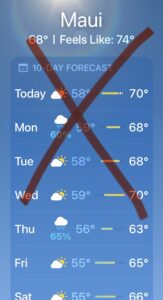
Don’t rely on generic weather apps, and don’t use the island – enter specific city instead! Rely on national or generic weather apps
Broad, mainland-focused weather apps—including the default iPhone weather app—are notoriously unreliable in Hawaii. Avoid using them for long-range forecasts, and be cautious even with same-day predictions, as they often fail to account for Hawaii’s highly localized conditions. - Search only by island name (e.g., “Maui”)
Never rely on an island-wide forecast. Always enter the specific town or area you’re visiting, as Hawaii’s microclimates can produce dramatically different weather conditions just a few miles apart. - Put too much weight on the forecast
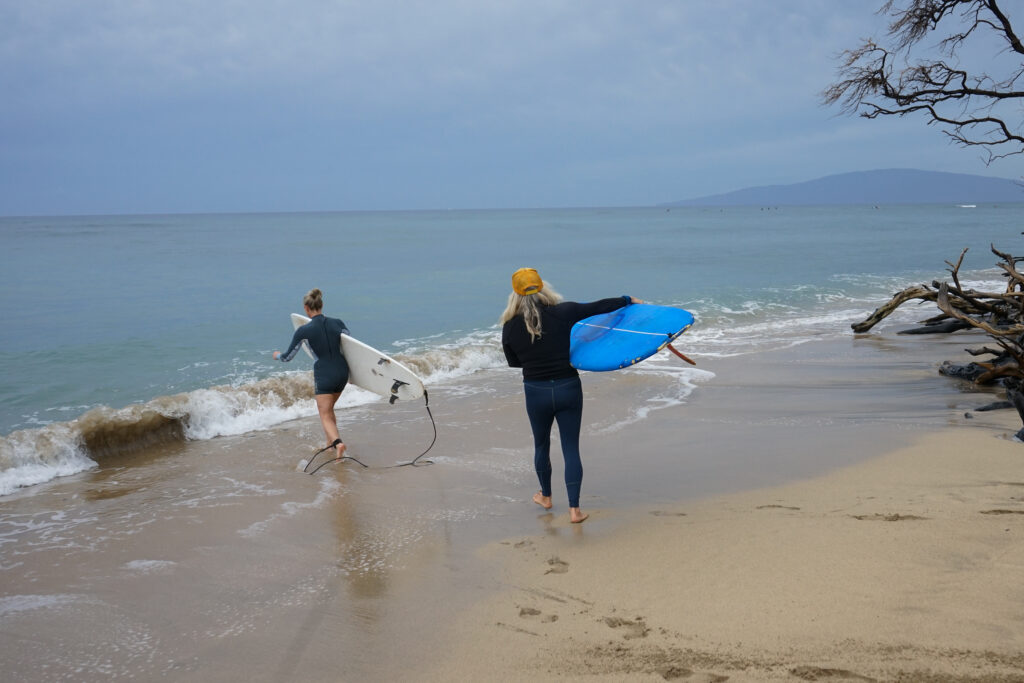
Weather forecasts in Hawaii are best viewed as general guidance, not absolute truth. As a recent example (as of this writing), on January 5, 2026, the entire state was under a flood watch due to an oncoming Kona low, yet most of Maui ended up receiving little to no rain. We had a completely full day of surf lessons planned, as it was still winter break rush, so we decided to do what we normally do – just head to the beach and check the conditions in the morning. It was a little cloudy and a slight onshore breeze (not the 30 knots predicted) and we were able to successfully run surf lessons all day! As a surf school, if we strictly followed the forecast, we would be canceling surf lessons unnecessarily. After more than 25 years of teaching surfing, we’ve learned the most reliable approach is to check ocean conditions in person before making decisions. Often, what’s forecasted as “bad weather” turns out to be perfectly safe—and enjoyable—for surfing, even if it’s a bit cloudy or breezy.
Hawaii Weather Forecasts: What to Do
 Use a local Hawaii-based weather app
Local meteorologists understand Hawaii’s unique weather patterns far better than national forecast models. The Hawaii Weather Now app from Hawaii News Now is a reliable option and generally more accurate than generic weather apps.- Start watching local Hawaii news before you arrive
One of the benefits of smart TVs is the ability to stream local news from anywhere. Download Hawaii News Now on Roku or your Smart TV and begin following trusted local meteorologists—especially Guy Hagi—to get familiar with how weather is discussed and predicted in Hawaii. - Follow trusted local alert pages on social media
If you use social media and are traveling to Maui, follow Maui 24/7 on Facebook or Instagram. These accounts are excellent sources for real-time emergency alerts, road closures, and practical, up-to-date local information. - Check HawaiiWeatherToday.com and tailor it to your island and activity
HawaiiWeatherToday.com is one of our favorite general forecasting resources. It breaks down daily weather by island, region, and activity, and explains conditions in clear, plain language with no technical jargon or confusing symbols. - Plan with flexibility and pack accordingly
This is Hawaii, where conditions can change quickly and unexpectedly—from volcanic activity and high surf to storms or road closures. Build flexibility into your itinerary by scheduling must-do activities early in your trip and leaving a few open days at the end for rescheduling or discovering new experiences.
When packing, a light sweatshirt or jacket is usually sufficient. Umbrellas are rarely used due to wind, and rain jackets are often unnecessary since rain is typically warm and brief—unless you’re heading into a rainforest area like Hana. Sneakers or slippers (flip-flops) work for most situations, with hiking shoes or sturdy sandals helpful for certain trails. Hats are always useful for sun and wind protection, though wide-brim hats without chin straps can be more cumbersome than practical.

Helpful Hawaii Weather Forecast Links
Besides all the links above, if you are looking for a bit more details, we love the following links and keep them bookmarked at all times –
Hawaii Weather – Anything Can Happen
Want to hear a funny story about how “anything can happen” on a Hawaiian vacation? My husband and teenage son were home on Maui this summer while I was in Florida with our other teenager, and they decided—at the last minute—to fly to Kona for a manta ray dive that evening. They booked the boat, a hotel, and a rental car, then got on a plane. By the time they landed just 30 minutes later, the entire state was under a tsunami watch.
They were able to pick up a rental car, but they couldn’t check into their oceanfront hotel. The manta ray dive was scheduled to depart at 6:00 p.m., and the first tsunami wave was predicted to arrive around 7:00 p.m., so the dive was—unsurprisingly—cancelled. Along with everyone else staying near the coast, they headed up the hill, waited several hours for pizza, and attempted to sleep in the rental car.
Thankfully, the tsunami did not cause any serious damage, and the all-clear was eventually announced. Around midnight, they were finally able to check into the hotel. The next morning, they decided to extend the trip by one day and were able to complete the manta ray dive that evening. In the end, it turned into an incredible memory—and a pretty unforgettable story.
Top Hawaii Weather Words to Know Before Your Trip to Hawaii
Trade Winds
The typical weather pattern in Hawaii includes trade winds—steady northeast winds of about 15–25 knots that help keep the islands cooler during the heat of the day. Trade winds are common year-round, tend to strengthen in the afternoons, and are usually strongest in the summer months.
Vog
When the trade winds aren’t blowing, a combination of volcanic emissions from Hawaiʻi Island and southerly winds can bring vog (volcanic haze) across the Hawaiian Islands, reducing air quality and visibility.
Kona Low
A Kona Low is a large-scale low-pressure weather system that forms west or northwest of the Hawaiian Islands and brings southerly (“kona”) winds instead of the usual trade winds. These systems can produce widespread cloud cover, heavy rain, thunderstorms and high surf.
Mauka / Makai
These Hawaiian directional terms are commonly used in local weather reports. Mauka means “toward the mountains” or uphill, while makai means “toward the ocean.”
Windward / Leeward
Also frequently used in forecasts, windward refers to the side of an island that faces the prevailing trade winds and typically receives more clouds and rain. Leeward refers to the sheltered, “lee” side of the mountains, which is generally drier, sunnier, and protected from the wind.
“Windward and Mauka Showers”
In weather reports, you’ll often hear the phrase “windward and mauka showers,” meaning rain is expected on the upwind side of the islands and along the mountain slopes. In Hawaii, this often means the northeast sides of the islands receive more rainfall—for example, Hilo on Hawaiʻi Island, Hana on Maui, and Hanalei on Kauaʻi.
Passing Showers
Brief, fast-moving rain showers common during trade-wind conditions, usually followed quickly by sunshine.
High Surf Advisory
A weather alert issued when ocean swells reach heights that may be hazardous for swimming, boating, and coastal activities.

Hawaii Weather Forecast- The Best Weather on the Planet
Hawaii is lucky to have incredible weather year-round, and it generally tends to be pretty boring—in the best possible way. Most days bring warm temperatures, steady trade winds, and conditions that are perfect for being outside, whether you’re at the beach, on the water, or exploring the island. While occasional storms or weather events do happen, they are the exception, not the rule. Understanding how Hawaii’s microclimates work, using local forecasting tools, and staying flexible with your plans will help you enjoy your trip with far less stress. When you plan smart and stay adaptable, Hawaii’s weather forecast becomes part of the adventure rather than an obstacle.